Product framework and development direction
How Abe turns healthcare governance problems into the work needed to solve them.
This framework explains how Abe is designed to connect a problem, its evidence and the work needed to solve it. Individual services are at different stages; this diagram is not a claim that every workflow or integration is available. See Services for current access.
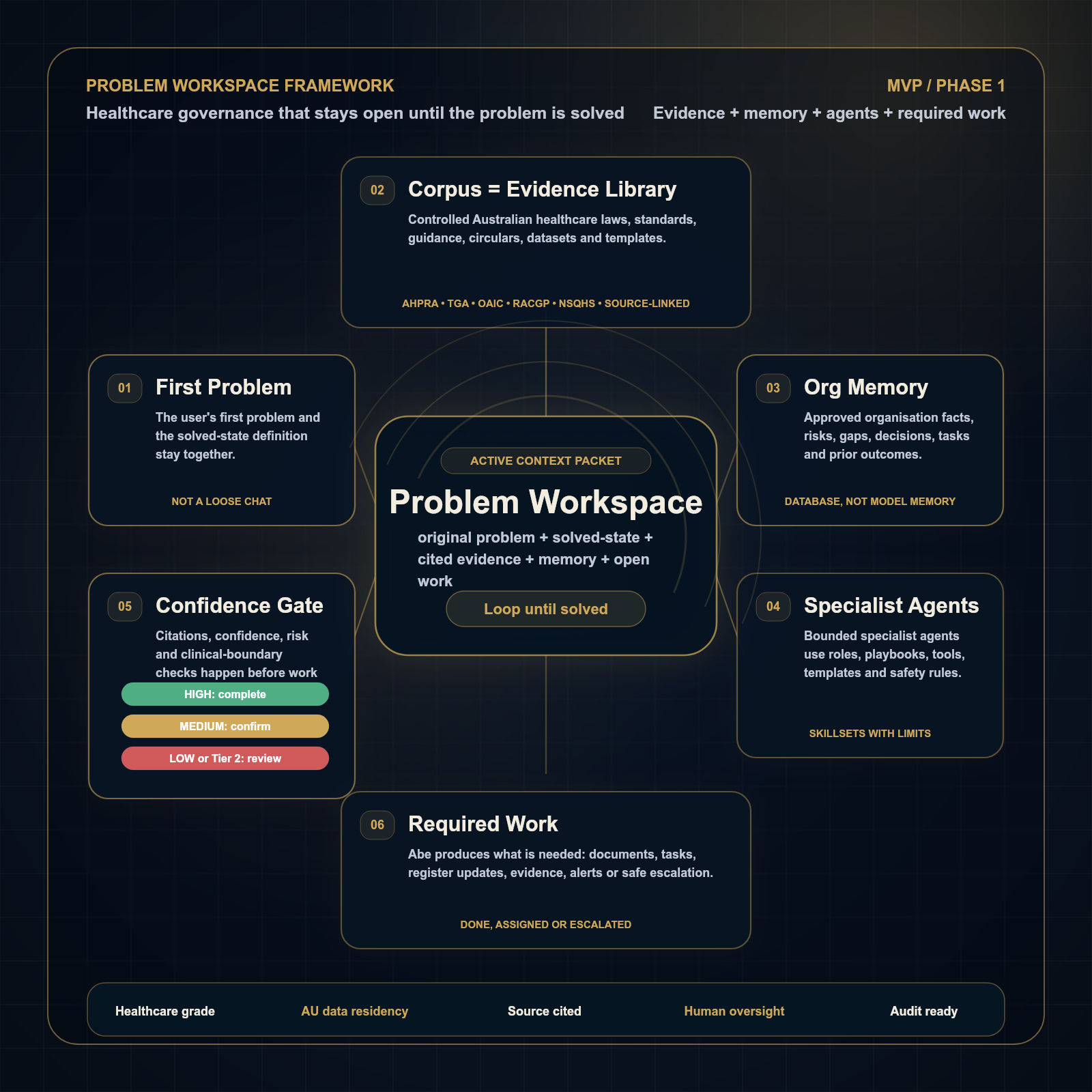 Framework
Product blueprint
The Problem Workspace Framework
The framework connects a healthcare governance problem with cited artefacts, assigned work, evidence and a clear review or escalation state. It describes the intended complete workflow; individual services and integrations must be checked separately on Services.
Problem Workspace
Original Problem
user input + constraints + why it matters
held together at all times
Solved-State Definition
required work produced • gaps closed or assigned • evidence ready
Trust Foundation — evidence library, memory and learning
Australian Healthcare Evidence Library
Corpus means Abe's controlled source library: AU laws, standards, regulator guidance, circulars and templates.
Organisation Memory
approved facts • prior assessments • known gaps • previous decisions
Session Events Log
append-only • immutable • every action recorded
What sits inside the evidence library
This is the Australian healthcare documentation Abe searches before it answers, drafts, assigns tasks or marks work as solved.
Source-linked, versioned, cited
Legislation + Rules
Privacy Act • APPs • My Health Record • National Law • sector Acts
Regulators
AHPRA • TGA • OAIC • ACSQHC • NDIS Commission
Standards
RACGP • NSQHS • aged care • NDIS • DIAS • EQuIP
Government Updates
circulars • consultations • guidance • reform notices
Templates + Evidence
policies • checklists • board papers • audit evidence
Funding + PHI
Medicare • private health insurance • grants where relevant
Versioned Evidence Sources
AHPRA • TGA • OAIC • Privacy Act • NSQHS • RACGP • aged care • NDIS • PHI
Agent Architecture + Skillsets
bounded roles • playbooks • templates • validators • tool permissions • action rules
Learning Loop
approved facts, decisions, tasks and outcomes update database memory, not hidden model training
Build Active Context Packet
A corpus is the evidence library Abe searches and cites. The evidence library and database memory are the source of truth. The model is not.
Abe AI Core
Agent 0 — Triage
Classify → Prioritise → Route
Reasoning Engine
retrieves from evidence library • cites source/version • reflects against solved-state
Action Engine
creates artefacts • updates registers • assigns tasks • records audit trail
Confidence + Safety Gate
Active Context Packet
problem + solved-state + cited evidence library + memory + open work
Specialist Agents
Outputs
Client outcome: the work needed to solve the problem
Abe produces whatever is required: documents, evidence, register updates, assigned tasks, citations, confidence status, audit trail, alerts or a safe escalation path.
Loop Until Solved
Reflection Loop
Does this output meet the solved-state? If no, revise or escalate.
Immutable Audit Trail
Every decision, citation, confidence score, version and review logged to database.
Abe does not rely on generic model memory. It retrieves from the Australian Healthcare Evidence Library, cites the source/version, scores confidence, writes to database memory and routes unsafe work to human review. It does not claim zero errors.
Why this is the MVP
The framework defines the first fundable loop: capture the problem, ground it in the Australian Healthcare Evidence Library, produce the required work, and close only when solved.
What it does not do
Phase 1 does not diagnose, prescribe, replace clinician judgement, ship autonomous Tier 2 clinical decision support, or silently retrain on client data.
How builds are reviewed
Every agent, evidence-library, memory, console or public-positioning PR must state which row it serves and how it preserves trust.